

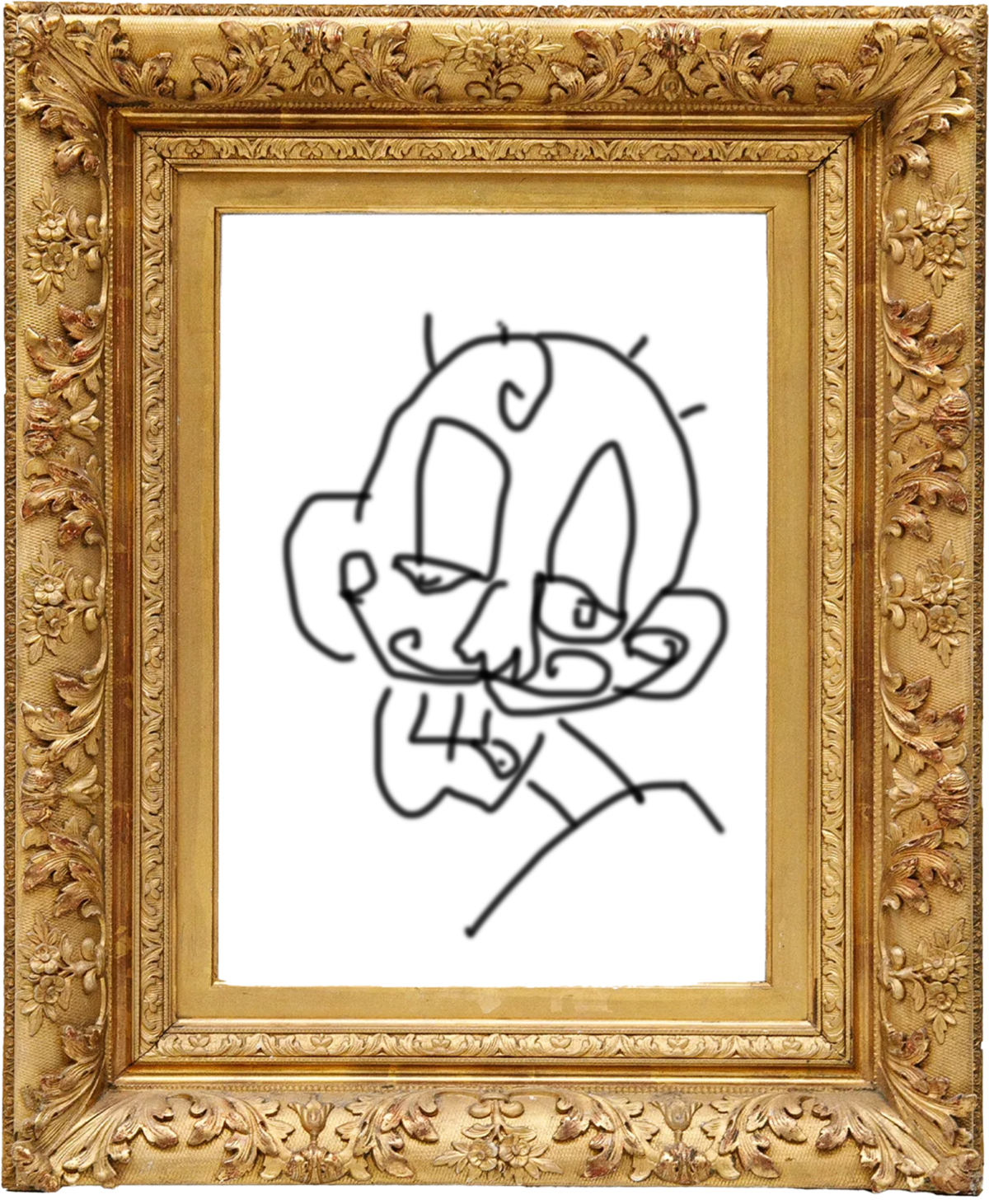
Graphic by Gabriel Currie
Since I was a boy, I knew I would one day be a great painter. Curators and critics would laud my genius and my work centuries after my death. My masterpieces would live on in the annals of Art History beside such legends as Dalí and Duchamp, gracing textbook pages and salon halls the world over. Life is ephemeral; my work is not.
Greatness started in my youth. I drew simple things: horses, landscapes, people. In that regard, my work has not changed. I honed my craft until I was miles ahead of my peers. But did the greats get hung up on technical skill? Obviously, some did. Everyone has seen a Rothko or a Pollock and thought, “I could do that.” But Rothko and Pollock did it already. What use is reinventing the wheel in the 21st century?
I look at today’s biggest names and wonder if following their path will make me great, too. By emulating others, I risk becoming one of countless middling wannabes who never make it and instead languish in odd jobs and mid-size galleries. To many of my contemporaries, the way to “make it” is to distill one’s practice into a formula, until one has two or three very specific things they are very, very good at. For some, that may be portraiture, or marble sculpture, or floral still lifes, or self-flagellating endurance-performances. For me, it is gesso.
Gesso is a primer that prevents oil paints from sinking into canvas and fading over time. When dry and sanded, it smooths the tooth of a rough surface, and when done just how I like it, it gleams like a freshly zamboni’d ice rink. With enough layers, a painting on a well-gessoed canvas will last centuries. I pour it over my ground and spread it thin, first with a knife, then a wide, soft brush until the whole surface gleams with a tacky, pearlescent sheen. In an hour, I return for another layer, and then another and another. With enough layers, a well-gessoed painting will last centuries. I spend days just gessoing, watching it rise as a solid mass from the canvas, layer upon layer, and I relish in the evidence of my dedication. It gets on my clothes and hands and shoes and I don’t wash it off.
What I paint is rather secondary to the Sisyphean task that precedes it, but my paintings themselves are timeless. The saying goes, “Write what you know.” I paint what I know: the sky, the night, nature, solitude, ennui, and, most importantly, myself, inserted into these otherwise mundane scenes. What matters is that the work is there, the touch of my hand is there, and thanks to my masterful gesso, it will stay. When I am long gone, my devotees will need a likeness to grace the covers of their biographies.
